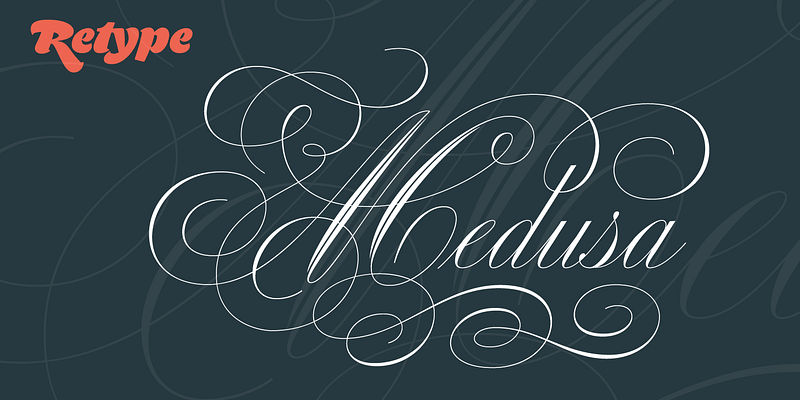
Medusa pays tribute to Ramón Stirling, an acclaimed Spanish calligrapher who worked in Barcelona from the mid-1800s. As a point of departure for this script, Ramiro Espinoza analyzed formal English handwriting and the ways in which it had been (mis)appropriated by the typographic technologies of different eras. Typefaces derived from roundhand scripts tend to be vulgarized and stripped of the beauty inherent in the canon of commercial handwriting. Espinoza decided that, rather than forcing the shape of complex letters to conform to technology, he would push technology to respect the original grace of the letters. Medusa features wildly ornate capitals that depart slightly from Stirling’s originals to hew more closely to the rest of the alphabet. Espinoza also drew several swashes and ligatures from scratch. And, unusually, the script includes a full set of small caps, carefully designed to create an all-caps setting that harmonizes with the classic copperplate script. A separate set of modular swashes can be used to create elaborate decorative headings and cartouches. Medusa won a Type Directors Club Certificate of Excellence in Type Design in 2014. Retype, 2014.