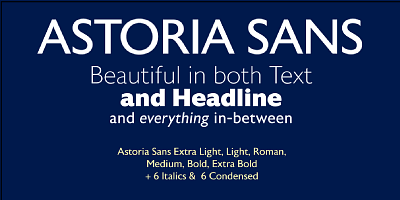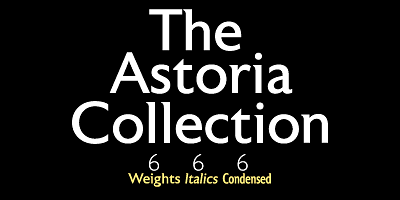
Based heavily on Gill especially in the mid weights, Astoria has a subtle top left serif which makes it not quite a Roman and not quite a Sans. Designed specificaly as a text face it still works very well as a headline font.
Alan Meeks
The Sans serif companion to Astoria. Based heavily on Gill especially in the mid weights and with a consistent series of condensed weights. Designed specifically as a text face it still works very well as a headline font.
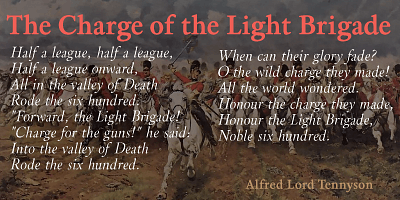
In searching for a Roman to use there were bits of Bembo, Times, Garamond etc. that I liked and bits that I did not. So I set out to take the best bits of all my favourite Romans and tried to create the ultimate Roman Typeface.
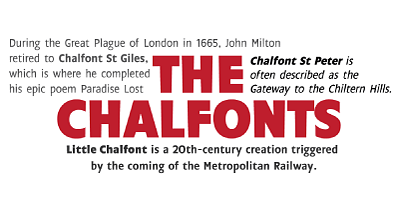
The typeface was designed after seeing a photocopy of some News Gothic text where the ink had faded on the bottom of each character. As character recognition is generally based on the top half of a character, readability was never compromised. Rather like Antique Olive the characters have a top heavy look when viewed straight on, however, as most type is
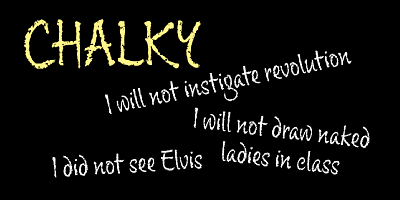
More condensed than most fonts of this style, Chalky can be used in relatively long settings without losing legibility.
Although a sans serif, Colosseum owes its style to the original Trajan Roman form. Borrowing some characteristics from Friz Quadrata, in its sans serif form it is more adaptable to text usage whilst still having a modern and original look which works well in headlines.
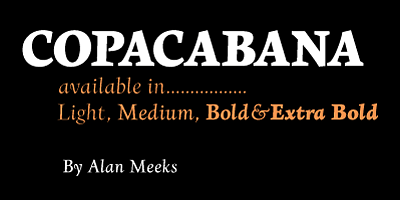
Copacabana is heavily based on one of my favorite typefaces Goudy Old Style Italic. It is sharper and more clearly defined than Goudy yet still retains its old style characteristics. The face is slightly angled so is basically upright whilst still retaining Italic characteristics
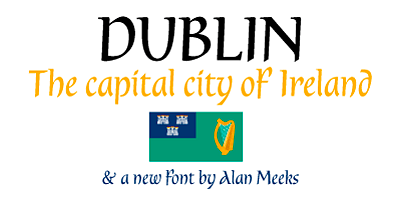
Classic Celtic style of lettering with an alternative set of capitals and a few alternative lower case.
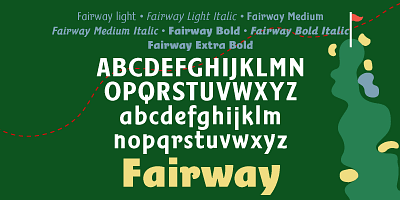
The thinking behind Fairway was to create a relatively conventional soft sans with a certain amount of movement at the top of the x-height line. The face is casual and quirky but can still be used as a text face.
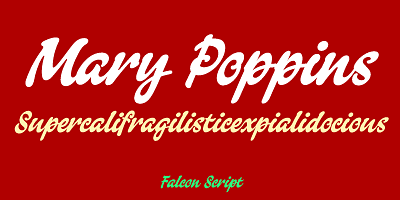
An informal version of Kestrel Script
Originally designed in 1985 and released by Letraset for dry transfer Lettering, Kestrel has, until now, never been digitized. The face now has been completely re-drawn and digitized for all formats. It is a heavy formal script similar in form to Commercial Script.
A Classic Italic Roman with a set of alternative swash caps and a number of original swash lower case charactures that can create a number of unusual ligatures when connecting to the preceding characters. Available in two weights Light and Bold.
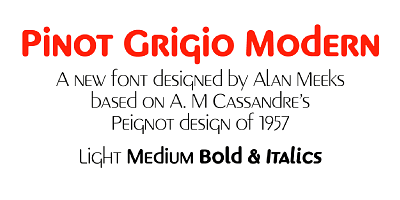
A modern update of the unique sans display font Peignot originally designed in 1937 by A. M. Cassandre. The font has been modernised by making all the terminals soft and making a larger x height and lessening the contrast between thick and thin.